The median ecommerce ROAS on Facebook ads is 2.79x–2.87x (AdAmigo, ROAS Tools). But that number tells you almost nothing about whether your campaigns are performing well. A 2.5x ROAS is outstanding for a low-margin fashion brand scaling cold traffic. That same 2.5x is a money pit for a high-margin supplement brand running retargeting only.
Most "good ROAS for Facebook ads" articles give you a useless "2–4x is good" range and call it a day. That's not helpful when you need to decide whether to scale a campaign, kill it, or rethink your strategy entirely. This guide gives you 2026 industry-specific ROAS benchmarks, the latest Advantage+ Shopping performance data (spoiler: 22% better than manual), a breakeven ROAS calculator, and clear rules for knowing when your numbers are actually good, or when they're hiding a problem. Pair it with our cost benchmarks for the full picture: what your ads cost and what they return.
Bottom line
- Overall ecommerce ROAS median: 2.79x–2.87x. Top performers hit 3.5x–5.0x+.
- Advantage+ Shopping Campaigns: Averaging 4.52x ROAS vs 3.70x for manual campaigns, a 22% lift.
- Prospecting vs retargeting: Cold traffic at 1.5–2.5x is normal. Retargeting at 4–8x is expected. Never compare them directly.
- Your breakeven ROAS: Calculate with 1 ÷ (1 − COGS% − OpEx% − Profit%). Everything above that number is profit.
- CPMs are up ~8% YoY: Rising costs mean you need stronger creative and tighter strategy to maintain ROAS.
What Is ROAS? (Quick Refresher)
ROAS = Revenue from ads ÷ Ad spend. Spend $1,000 on Facebook ads, generate $3,000 in sales, and your ROAS is 3.0x. Simple math, but it's deceptive. ROAS tells you efficiency, not profitability. Two brands can both hit 3x ROAS and end up in completely different financial positions.
The difference is margins.
- Brand A: 70% gross margin, 3x ROAS. For every $1,000 in ad spend they generate $3,000 in revenue, keep $2,100 in gross profit, and pocket ~$1,100 after ad costs. Healthy.
- Brand B: 30% gross margin, 3x ROAS. Same $3,000 revenue, but only $900 in gross profit, which doesn't cover the $1,000 ad spend. They're losing $100 on every dollar they spend.
This is why your breakeven ROAS matters more than any industry benchmark. We'll walk through the calculation below.
ROI = (Revenue − Ad Spend) ÷ Ad Spend. It subtracts your cost. ROAS doesn't. A 3x ROAS equals a 200% ROI. Meta Ads Manager reports ROAS, so that's what most media buyers use day-to-day. Just remember to convert it to actual profit using your margins before making scaling decisions.
2026 Facebook Ads ROAS Benchmarks by Industry
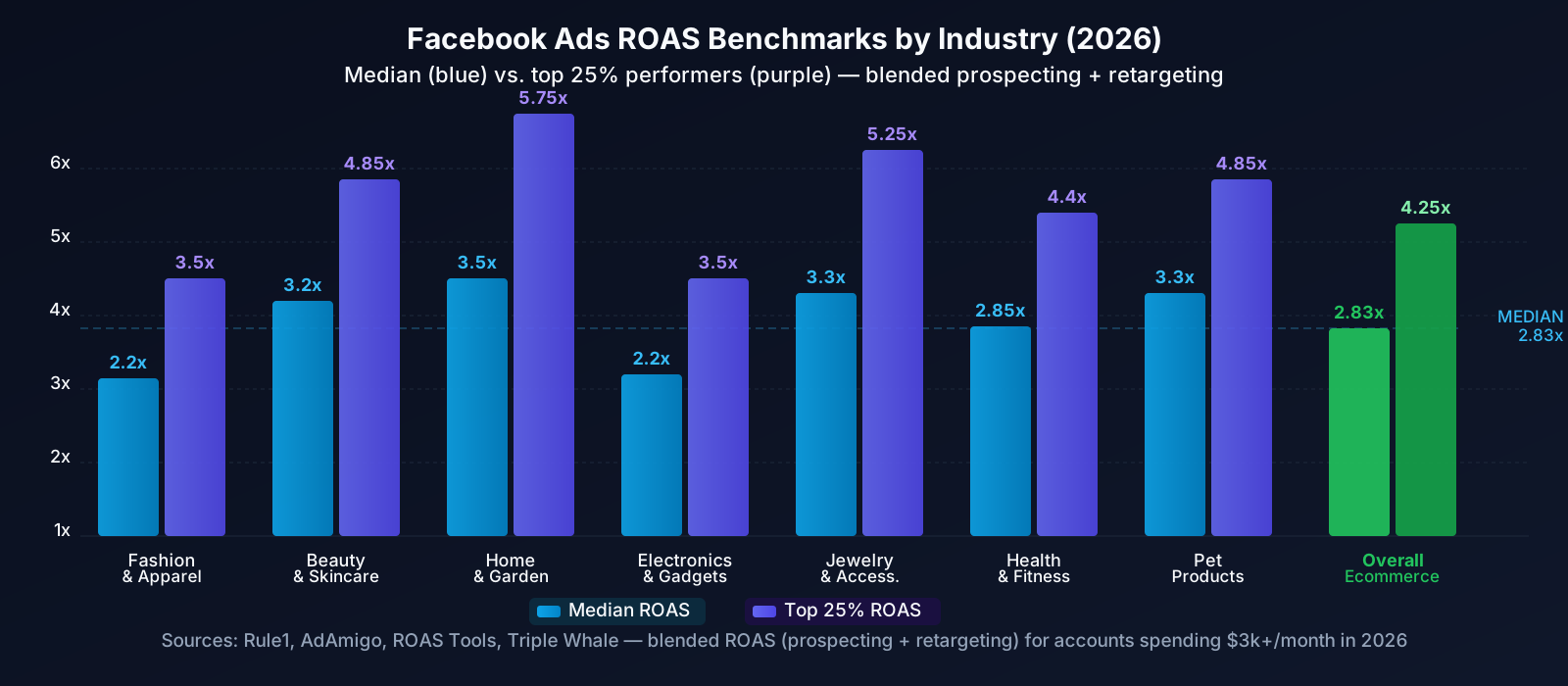
Here are the ROAS benchmarks for Facebook ads in 2026, aggregated from Rule1, AdAmigo, ROAS Tools, and Triple Whale. These represent blended ROAS (prospecting + retargeting combined) for established ecommerce brands spending at least $3k/month.
| Industry | Median ROAS | Top 25% | Notes |
|---|---|---|---|
| Fashion & Apparel | 1.8x–2.5x | 3.0x–4.0x | Highest competition, thin margins, high return rates |
| Beauty & Skincare | 2.8x–3.6x | 4.2x–5.5x | Repeat purchases and subscriptions boost LTV |
| Home & Garden | 3.0x–4.0x | 5.0x–6.5x | Higher AOV, lower auction pressure |
| Electronics & Gadgets | 1.8x–2.6x | 3.0x–4.0x | Returns and support costs eat into effective margin |
| Jewelry & Accessories | 2.8x–3.8x | 4.5x–6.0x | High margins support strong numbers |
| Health & Fitness | 2.4x–3.3x | 3.8x–5.0x | Supplements and subscriptions help retention |
| Pet Products | 2.8x–3.8x | 4.2x–5.5x | Loyal customers, high repeat rate |
| Food & Beverage | 2.2x–3.0x | 3.5x–4.5x | Subscription models outperform one-time |
| Overall Ecommerce | 2.79x–2.87x | 3.5x–5.0x+ | Aggregated median across all verticals |
A few things jump out:
Fashion is the toughest vertical on this list. High competition, razor-thin margins, and return rates that can hit 30%+. If you're a fashion brand holding 2.5x blended ROAS, you're outperforming most of your competitors. Don't kill that campaign because someone told you "3x is the minimum."
Home & Garden and Jewelry consistently outperform. Higher AOV means each conversion carries more revenue relative to ad cost. A $200 garden furniture sale at 3x ROAS generates $600 in revenue per $200 spent on ads. A $30 t-shirt at the same 3x ROAS generates $90. The math favors higher-priced products.
The gap between median and top 25% is massive. Top performers aren't just slightly better, they're often running 1.5–2x the ROAS of the median. According to InsightIQ's 2026 benchmark data, the difference usually comes down to creative quality, offer strategy, and landing page conversion rates. Not budget size.
Warning: These benchmarks represent blended ROAS across campaign types. A prospecting-heavy account will always look worse than a retargeting-heavy one. Always compare apples to apples. Also, iOS attribution loss means Meta's reported ROAS is typically 20–40% lower than actual. If you haven't addressed attribution gaps, your real performance is likely better than what you see in Ads Manager.
Advantage+ Shopping vs Manual Campaigns
This is the biggest performance story of 2026. Advantage+ Shopping Campaigns (ASC) are pulling significantly ahead of manual campaign setups, and the data backs it up.
According to AdAmigo's 2026 benchmark data, Advantage+ Shopping Campaigns average 4.52x ROAS compared to 3.70x for manual campaigns, a 22% lift. ROAS Tools reports consistent findings across their dataset.
Here's what we're seeing:
| Campaign Type | Average ROAS | Best For |
|---|---|---|
| Advantage+ Shopping | 4.52x | Established catalogs, proven creative, scaling spend |
| Manual Campaigns | 3.70x | Granular control, creative testing, niche audiences |
| Dynamic Product Ads (DPA) | 2.8x–5.5x | Retargeting + prospecting catalog blends |
Why ASC outperforms. Meta's algorithm gets more signals and more flexibility with Advantage+ campaigns. It can test audience segments, placements, and creative combinations faster than any human media buyer. The trade-off is control, you're handing optimization decisions to the machine.
When manual still wins. If you're testing new creative angles, launching a new product, or targeting a very specific niche audience, manual campaigns give you the visibility to learn what's working. We run both in most accounts: ASC for proven winners, manual for testing and discovery.
Advantage+ Shopping performs best when you give it a large library of proven creative assets. Don't dump untested ads into ASC and hope for the best. Test creative in manual campaigns first, identify winners, then feed those into Advantage+ to scale. This is how top accounts consistently hit 4x+ ROAS on ASC.
ROAS by Campaign Type
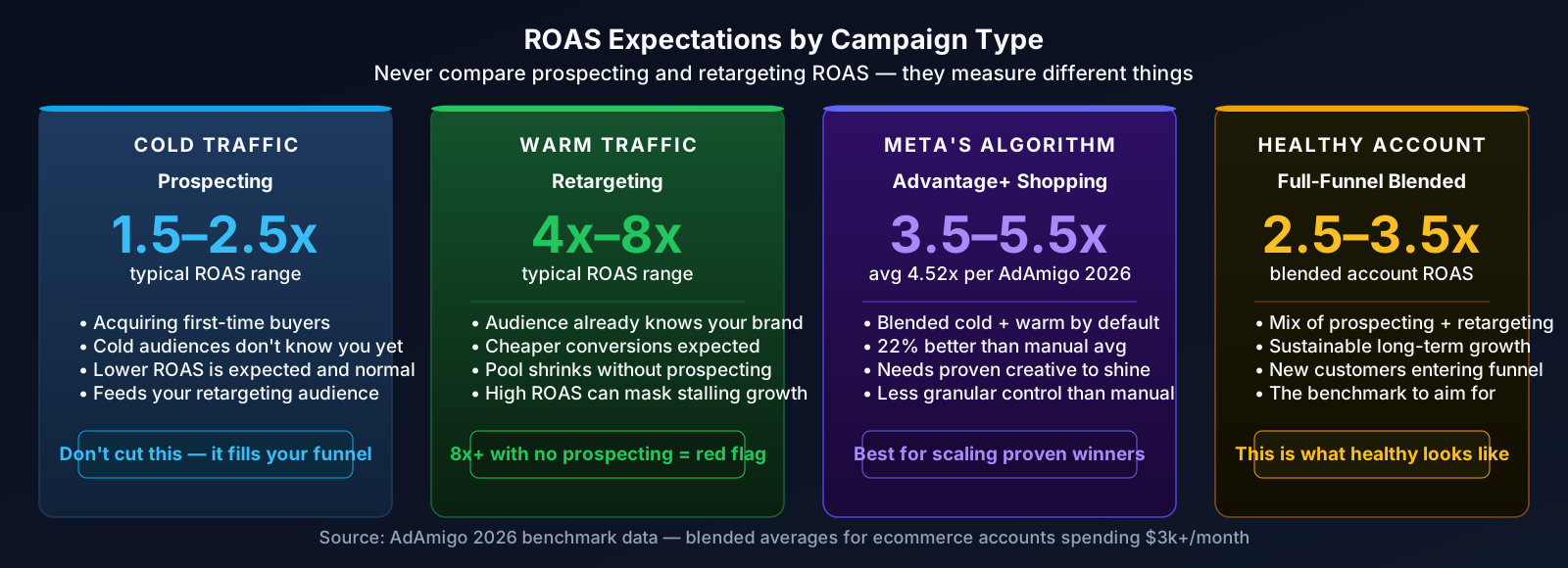
Never judge prospecting and retargeting by the same ROAS standard. This is one of the most common mistakes we see, brands averaging their entire account ROAS and panicking because it's "only" 2.5x, when their prospecting campaigns are working exactly as expected.
| Campaign Type | Typical ROAS Range | What to Expect |
|---|---|---|
| Prospecting (cold) | 1.5x–2.5x | You're paying to acquire first-time buyers. This is customer acquisition cost. |
| Retargeting (warm) | 4x–8x | They already know you. Conversion should be cheaper. |
| Advantage+ Shopping | 3.5x–5.5x | Blended by default, Meta mixes cold and warm traffic. |
| Full-funnel blended | 2.5x–3.5x | Healthy account with a mix of prospecting and retargeting. |
Here's my take: if your prospecting campaigns hit 2.0x ROAS and your retargeting hits 6x, your account is healthy. The prospecting feeds the retargeting pool, which closes the sales. Cutting prospecting because its ROAS looks "low" shrinks your retargeting audiences and eventually tanks your overall performance.
For a detailed look at structuring campaigns across the funnel, check our full-funnel Facebook ads strategy guide.
Warning: An account running only retargeting at 8x ROAS is not healthy, it's stalling. You're converting people who already know you and not bringing new customers into the top of funnel. That 8x number will shrink as your warm audiences dry up. Prospecting and retargeting need to work together.
ROAS by Product Price Point
Your AOV (average order value) changes what "good" ROAS looks like. Lower-priced products need higher ROAS to cover acquisition costs as a percentage of revenue. Higher-priced products can sustain lower ROAS and still be very profitable.
| Price Range | Typical ROAS Needed | Why |
|---|---|---|
| Under $50 | 4.0x+ | Ad costs eat a larger share of each sale. Tight margins demand high efficiency. |
| $50–$150 | 2.5x–3.5x | Sweet spot for most DTC brands. Enough margin to absorb acquisition cost. |
| $150–$500 | 2.0x–3.0x | Higher revenue per sale means ad cost is a smaller slice of the pie. |
| $500+ | 1.5x–2.5x | Even modest ROAS can mean strong profit per order. |
A luxury furniture brand at 1.8x ROAS on a $800 AOV might be clearing $200+ profit per order after ad costs. A $25 accessories brand at 3.0x ROAS might be netting $5. The ROAS number means nothing without the unit economics behind it.
The Video & Reels Effect on ROAS
Video and Reels now account for over 40% of all Facebook and Instagram ad impressions (InsightIQ), and that share is growing every quarter. This shift is reshaping ROAS benchmarks in two ways.
Reels CPMs are still cheaper. Feed CPMs run $10–$16 while Reels sit at $4–$8 (see our cost benchmarks breakdown for detailed placement data). Lower CPMs mean your ad spend goes further, which directly improves ROAS when conversion rates hold steady.
But creative quality is the real variable. According to Rule1's 2026 analysis, creative quality now drives 50–70% of campaign performance. That stat shouldn't surprise anyone who's managed Facebook ads recently. The algorithm can find buyers, but it needs scroll-stopping creative to convert them.
Here's what's working on Reels right now:
- UGC-style testimonials outperform polished brand content by 30–50% on ROAS in most verticals
- First 3 seconds decide whether someone watches or scrolls past. Lead with a hook, not your logo.
- Native-feeling content that matches organic Reels performs best. If it looks like an ad, people skip it.
With CPMs up ~8% year-over-year across the platform (ROAS Tools), creative quality is the clearest path to maintaining or improving ROAS. You can't control auction prices. You can control what you show people.
Don't just resize your feed ads for Reels. Create native vertical video designed specifically for the format. We consistently see 20–40% better ROAS from purpose-built Reels creative versus repurposed static-to-video conversions. If it looks and feels like organic content, the algorithm rewards it with cheaper delivery.
Calculate Your Breakeven ROAS
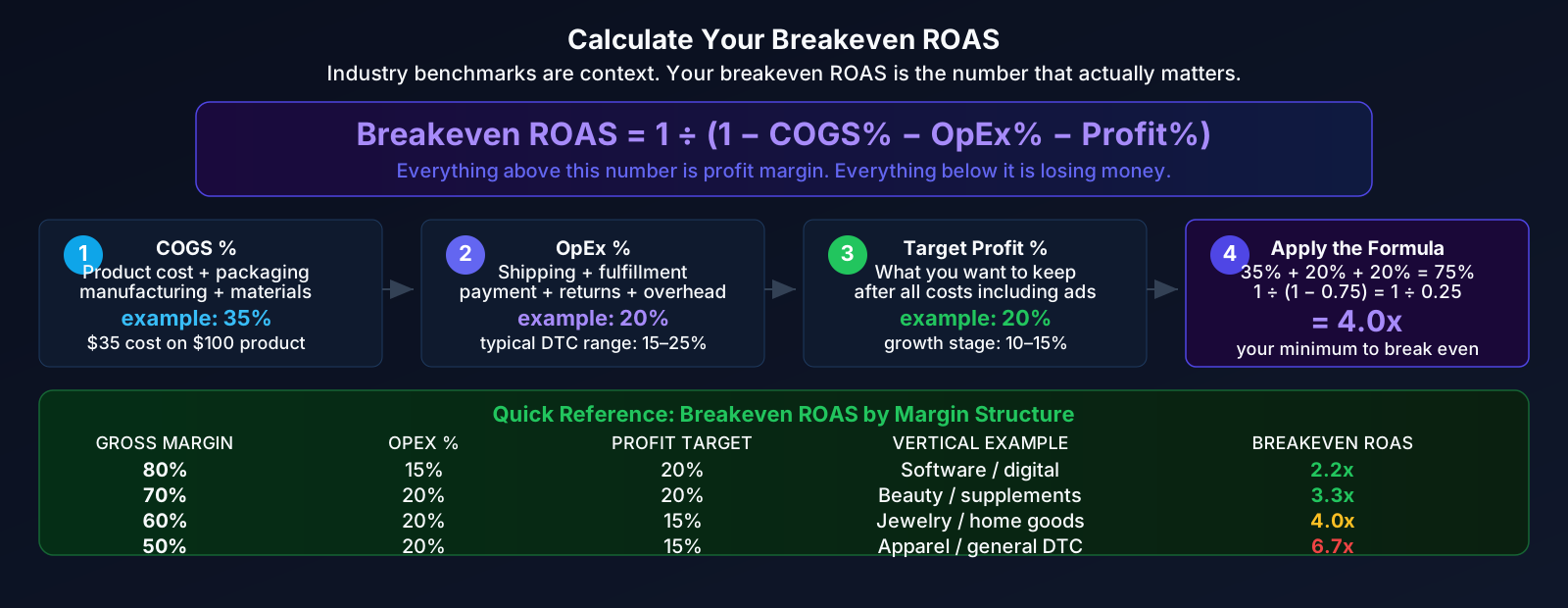
Industry benchmarks are useful for context, but your breakeven ROAS is the number that actually tells you whether a campaign is making or losing money. Here's how to calculate it:
Determine Your COGS Percentage
What percentage of revenue goes to product cost? If you sell a product for $100 and it costs $35 to make and package, your COGS is 35%. Include raw materials, manufacturing, and packaging.
Add Operating Expenses as % of Revenue
Fulfillment, shipping, payment processing, returns, customer service, and overhead. For most ecommerce brands this runs 15–25% of revenue. Use 20% if you're not sure of your exact number.
Set Your Target Profit Margin
How much do you want to keep after all costs including ads? For growth-stage brands, 10–15% is realistic. Established brands with proven channels target 20–30%.
Apply the Breakeven Formula
Breakeven ROAS = 1 ÷ (1 − COGS% − OpEx% − Profit%)
Example: 35% COGS + 20% OpEx + 20% target profit = 75% of revenue accounted for. That leaves 25% for ad spend.
Breakeven ROAS = 1 ÷ 0.25 = 4.0x
You need at least 4.0x ROAS to hit your 20% profit margin with this cost structure. Aim for 4.5x+ to build in a buffer for slow weeks and seasonal swings.
Quick Reference: Breakeven ROAS by Margin Structure
| Gross Margin | OpEx % | Profit Target | Breakeven ROAS |
|---|---|---|---|
| 80% (software, digital) | 15% | 20% | 2.2x |
| 70% (beauty, supplements) | 20% | 20% | 3.3x |
| 60% (jewelry, home goods) | 20% | 15% | 4.0x |
| 50% (apparel, general DTC) | 20% | 15% | 6.7x |
| 40% (electronics, food) | 20% | 10% | 10.0x |
If your margin structure puts breakeven ROAS above 6x, your business model may not support cold-traffic Facebook ads at scale. In that case, focus on retargeting, improving margins, increasing AOV, or building LTV through subscriptions and repeat purchase programs.
When "Low" ROAS Is Actually Fine
Not every campaign needs to hit your target ROAS to be valuable. Here are five situations where below-benchmark ROAS is perfectly acceptable:
You're in a testing phase. New creative, new audiences, new offers, all require a learning investment. ROAS of 1.5–2.0x during testing is normal and expected. The goal is data, not profit. Cut tests that show zero promise, but give promising ones room to optimize.
You're a new brand building awareness. First-time buyers cost more to acquire. Early ROAS of 1.5–2.5x is typical for brands under 6 months old on the platform. You're buying pixel training and market data as much as you're buying sales.
You sell high-LTV products. Subscriptions, consumables, and replenishment products mean a customer's first purchase is just the beginning. A 2x first-purchase ROAS can turn into 6–8x over 12 months if your retention is strong. Optimize for LTV, not first-touch ROAS.
You're expanding into new markets. New geographies, new demographics, or new product categories all reset the algorithm's learning. Expect lower ROAS for 2–4 weeks while the system calibrates to new audience signals.
Top-of-funnel is feeding your retargeting pipeline. Awareness and reach campaigns at 1.0–1.5x ROAS are fine if they're filling your retargeting pool with qualified visitors. The value shows up in your retargeting campaigns, not in the awareness campaign itself.
When "Good" ROAS Is Hiding a Problem
High ROAS isn't automatically good. This is where teams get lulled into bad decisions: the dashboard looks healthy, but the business is not actually growing. Watch for these red flags:
Retargeting-only at 8x+. If your only campaigns are retargeting, that 8x ROAS is flattering but unsustainable. Your audience pool is finite. Without prospecting to refill it, performance will decay month over month until you're retargeting the same 500 people repeatedly.
Tiny budget with inflated ROAS. A $500/month campaign at 6x ROAS isn't proof of concept, it's noise. Small sample sizes create high variance, and increasing budget almost always brings ROAS down to more realistic levels. Test whether your performance holds at 2–3x the current spend before making plans around it.
Short attribution window. If you're measuring on 1-day click only, you're missing conversions that happen over the next 6 days. Your ROAS might look lower than reality, or you've accidentally over-optimized for impulse buyers and missed higher-value customers who research before purchasing.
Wrong revenue math. If your ROAS calculation includes gross revenue but ignores refunds, returns, and discounts, you're overstating performance. A beauty brand with 15% return rates needs to calculate ROAS on net revenue for an accurate picture.
Your ads aren't converting new customers. If your ads aren't converting cold traffic and the only revenue comes from warm audiences, the ROAS number is misleading. You're not growing, you're harvesting.
A campaign at 3.5x ROAS generating $8,000 in monthly profit beats a campaign at 6x ROAS generating $1,200 in profit. When scaling, maximize total profit dollars, not the ROAS ratio. Your bank account doesn't care about percentages.
How to Improve Your ROAS
If your ROAS is consistently below your breakeven threshold, here's where to focus, in order of typical impact:
1. Fix Your Creative
Creative quality drives 50–70% of campaign performance (Rule1). If your ROAS is declining, stale creative is the most likely culprit. Watch for signs of creative fatigue, frequency climbing above 3, CTR dropping week over week, and CPAs rising on the same audiences.
What to do: test new hooks, new formats (especially Reels), and genuinely different angles. Don't just swap background colors. Change the message. Study what competitors are running for creative concepts you haven't tried yet.
2. Optimize Your Audiences
Broad targeting works well in 2026, but "broad" doesn't mean "no strategy." Exclude past purchasers from prospecting campaigns. Test lookalikes based on your highest-value customers, not all customers. Reverse-engineer competitor targeting to find audience segments you've overlooked.
3. Improve Your Landing Page
Your conversion rate is the multiplier that turns clicks into revenue. A landing page converting at 3% versus 1.5% doubles your effective ROAS without changing a single ad. Page speed, mobile optimization, clear CTAs, and social proof are the fundamentals. Most brands underinvest here.
4. Test Your Offers
Free shipping thresholds, bundle pricing, limited-time discounts, gift-with-purchase. Small changes to your offer can move ROAS by 20–50%. Test systematically and measure incrementally, don't overhaul everything at once.
5. Increase AOV
Upsells, cross-sells, quantity discounts, and free-shipping thresholds all boost revenue per order without increasing ad cost. A $10 AOV increase on a $60 average order improves your effective ROAS by roughly 17%.
6. Fix Attribution
If you haven't addressed iOS attribution gaps, your reported ROAS is likely 20–40% lower than reality. Implement server-side tracking (Conversions API), set up UTM tagging, and consider third-party attribution tools. Get an accurate picture before making optimization decisions based on flawed data.
ROAS Benchmarks at a Glance
| Dimension | "Good" ROAS Range | When to Investigate |
|---|---|---|
| Blended ecommerce | 2.79x–3.5x | Consistently under 2.0x |
| Prospecting (cold) | 1.5x–2.5x | Under 1.2x for 2+ weeks |
| Retargeting (warm) | 4x–8x | Under 3x (audience or creative issue) |
| Advantage+ Shopping | 3.5x–5.5x | Under 3x (creative library or catalog issue) |
| Low AOV (< $50) | 4.0x+ | Below your breakeven calculation |
| Mid AOV ($50–$200) | 2.5x–3.5x | Below your breakeven calculation |
| High AOV ($200+) | 1.5x–2.5x | Below your breakeven calculation |
Your breakeven ROAS from the calculator above should always override these generic ranges. A brand with 80% margins might be profitable at 1.5x. A brand with 40% margins might need 5x+. Your cost structure beats benchmarks every time.
Want to see what's driving ROAS in your category?
Browse a finished competitor report on a real brand: the scorecard, top creatives, offers in market, and hook themes worth testing. Pulled from the public Ad Library, so no private spend or ROAS, just what's running. Free, no login.
See Sample ReportsWhat to remember
-
The median ecommerce ROAS on Facebook ads is 2.79x–2.87x in 2026. Top performers hit 3.5x–5.0x+. Your industry vertical and margins determine what "good" means more than any generic benchmark.
-
Advantage+ Shopping outperforms manual campaigns by 22% (4.52x vs 3.70x average ROAS). If you have proven creative and an established product catalog, ASC should be a core part of your strategy.
-
Prospecting at 1.5–2.5x ROAS is normal and healthy. Retargeting at 4–8x is expected. Never average them together and panic about the blended number.
-
Calculate your breakeven ROAS with 1 ÷ (1 − COGS% − OpEx% − Profit%). This is the only number that tells you whether a campaign is actually profitable for your business.
-
Creative quality drives 50–70% of performance. With CPMs up ~8% YoY, better creative is the most reliable path to maintaining or improving ROAS. Test new formats, especially Reels.
-
iOS attribution underreports ROAS by 20–40%. Fix your attribution setup before making drastic decisions based on the numbers Meta shows you.
-
Optimize for total profit dollars, not ROAS in isolation. A lower-ROAS campaign generating more absolute profit is a better campaign than a high-ROAS campaign on a tiny budget.
Sources
- Rule1: ROAS Benchmarks by Industry (2026). Industry-level ROAS data and creative performance analysis.
- AdAmigo: Meta Ads ROAS Benchmarks by Industry 2026. Advantage+ Shopping vs manual campaign performance data.
- ROAS Tools: ROAS Industry Benchmarks 2026. Cross-industry ROAS medians and CPM trend analysis.
- InsightIQ: 2026 E-Commerce Ad Benchmarks. Video/Reels impression share and creative quality metrics.
- Triple Whale: Facebook Ad Benchmarks by Industry. Ecommerce ROAS data by vertical and campaign type.
Benchmark data represents medians across thousands of ad accounts. Individual results vary based on creative quality, targeting precision, landing page experience, offer strength, and competitive dynamics in your specific niche.