
Your Facebook ads were printing money last month. Now they're barely breaking even. Same audiences. Same budgets. Same products. But ROAS has been sliding for two weeks straight and nothing you've changed is helping.
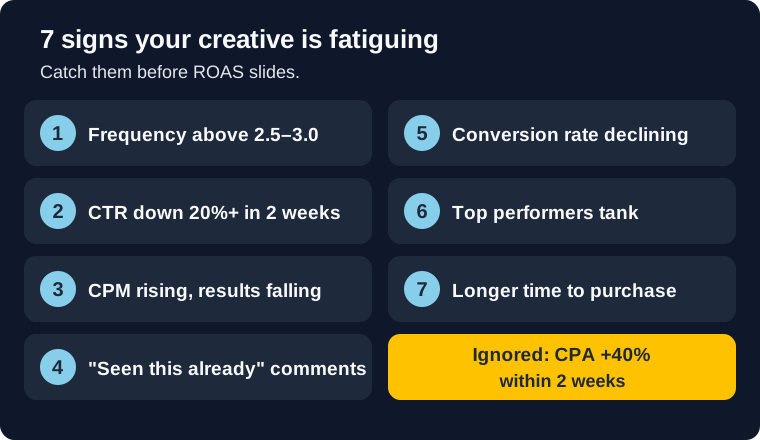
This is the most common panic call we get. "Nothing changed, but performance dropped 40%!" After pulling the account data, it's almost always the same culprit: creative fatigue. Top-performing ads lose roughly 38% of their effectiveness after just 5 weeks running unchanged. And when fatigue goes ignored, average CPA rises 40% within two weeks.
Fatigue doesn't announce itself. Your ads just stop working. Once you know the signals, you can catch it before it wrecks your ROAS.
If you're managing client accounts at $1k–$10k/mo and need a defensible refresh cadence to bring to a QBR (spend-band thresholds, a 14-day diagnostic, and a worked example), pair this post with the creative fatigue detection playbook for agencies.
Bottom line
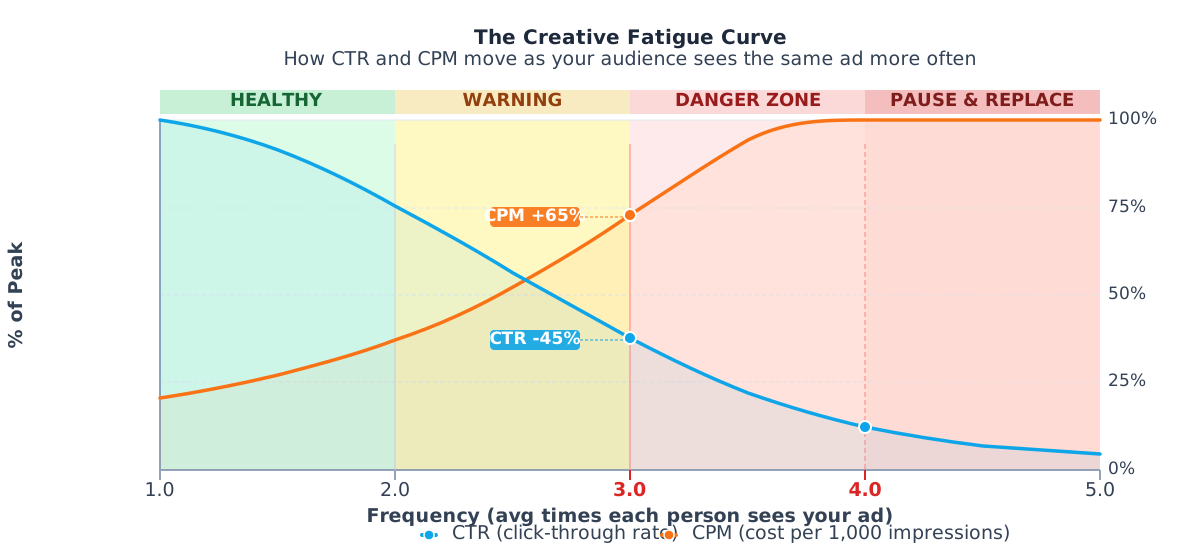
- Frequency above 2.5–3.0 is the danger zone. Above 4.0 is critical.
- CTR dropping 20%+ over two weeks = confirmed fatigue.
- Meta's peak window is days 7–21. Most ads start declining by week 3–4.
- CPA rises 40% within 2 weeks when fatigue is ignored.
- You don't have to start over. Swapping the first 3 seconds of a video can reset Meta's algorithm.
What Is Creative Fatigue?
Creative fatigue happens when your audience has seen your ad so many times their brains tune it out. Tailored Edge Marketing describes it as the point where repeated exposure shifts from building familiarity to triggering active avoidance.
Here's the death spiral:
- People stop engaging. Fewer clicks, no comments, no shares. They've seen it before.
- Meta's algorithm notices. Lower engagement = lower relevance score.
- CPMs go up. Meta charges more because your ad isn't performing in the auction.
- Delivery slows. Meta shows your ad to fewer people because it's losing relevance.
- ROAS dies. You're paying more and converting less.
Most ads hit peak performance between days 7 and 21 (GetKoro). After that window, fatigue sets in fast. Ecommerce brands with smaller audiences (under 500K) can hit fatigue in 1–2 weeks. Larger audiences buy you 3–4 weeks at best.
Why fatigue hits faster in 2026: Meta's Advantage+ concentrates delivery on your highest-performing audience segments. That's great for initial ROAS, but it saturates your best buyers faster. What used to take 4 weeks to fatigue now takes 2–3 weeks. You have less runway to catch it (Segwise).
The 7 Signs
1 Frequency Above 2.5–3.0
Frequency is the most direct fatigue indicator. It tells you how many times, on average, each person has seen your ad. Higher frequency = more fatigue.
| Frequency | Status | What to Do |
|---|---|---|
| Below 2.0 | Healthy | Keep running |
| 2.5–3.0 | Warning zone | Monitor daily, prep replacements |
| 3.0–4.0 | Danger zone | Refresh or rotate immediately |
| 4.0+ | Critical | Pause and replace (Adligator) |
How to check: Go to Ads Manager → Customize Columns → add "Frequency." Check it at the ad level, not campaign level. Campaign-level frequency hides individual ad saturation.
Frequency varies wildly by placement. Instagram Stories might sit at 5.0 while Facebook Feed is at 2.0. Use the placement breakdown to find the fatigued placement and pause it while keeping the others running.
2 CTR Dropping Week Over Week
CTR is usually the first metric to move. People see your ad, recognize it, and scroll past without clicking. Adbid.me flags a 10–15% week-over-week decline as an early signal. A 20%+ decline over two consecutive weeks is confirmed fatigue.
Here's a typical decline pattern:
| Week | CTR | Status |
|---|---|---|
| Week 1 | 2.1% | Fresh creative, strong engagement |
| Week 2 | 1.8% | Slight decline, still healthy |
| Week 3 | 1.4% | 33% drop from peak, fatigue confirmed |
| Week 4 | 0.9% | Severe fatigue, refresh overdue |
The rule: If CTR drops 20%+ over two weeks, don't wait. Refresh the creative now.
Don't rely on industry averages here. If your ads were hitting 2.1% CTR and dropped to 1.4%, that's a problem even if 1.4% beats most industry benchmarks. Your past performance is your best comparison.
3 CPM Rising While Results Drop
Rising CPM + dropping conversions = the fatigue death spiral. Meta's auction rewards engaging ads. When engagement falls:
- Your relevance score drops
- You lose auction competitiveness
- Meta charges more per 1,000 impressions
- Budget efficiency tanks
- Results decline further
What to watch for: CPM increasing 15–20% while CPA climbs simultaneously. That double hit, paying more and converting less, is the clearest sign your creative has gone stale.
Don't blame seasonality. CPMs rise during Q4 and Black Friday. But if your CPM is up 30% outside a high-competition period, that's fatigue. Compare to your own cost data from the same period last year.
4 Negative Comments About Repetition
When people start complaining in the comments, fatigue has been building for a while:
- "Why do I keep seeing this ad?"
- "This is the 10th time I've seen this"
- "Stop showing me this!"
- "I already bought this, leave me alone"
That last one is telling. It means your exclusion audiences need work. You're burning budget showing ads to existing customers.
How to check: Open Ads Manager → click the ad preview or "See Post" → read the comments. Do this weekly.
Negative comments usually appear before metrics tank. If you see repetition complaints, refresh immediately, even if the numbers still look okay. It's cheaper to refresh early than to recover from a dead campaign.
5 Conversion Rate Declining Despite Steady Traffic
This one is sneaky. CTR looks fine, traffic holds steady, but conversions drop.
As your best segments fatigue, Meta shifts delivery to less-interested users to fill impressions. People who already decided not to buy still click out of curiosity. And repeated exposure stales the offer: the "limited time" angle loses its punch by the fifth impression.
What to track: Compare ad-level CTR against landing page conversion rate. Stable CTR + falling conversions = fatigue sending you lower-intent traffic. If your ads aren't converting, creative fatigue should be the first suspect.
6 Top Performers Suddenly Tank
Your best ad has been crushing it for three weeks. Great ROAS, efficient CPA, consistent volume. Then it falls off a cliff overnight.
This happens because your best ads fatigue fastest. Meta's algorithm pushes winning creative hardest to high-intent segments. Those segments saturate first. GetKoro notes this acceleration is even more pronounced with Advantage+ campaigns, which aggressively concentrate delivery.
| Scenario | What It Means |
|---|---|
| One ad tanks, others stable | That specific creative is fatigued |
| All ads tank simultaneously | Audience fatigue. They've seen everything. |
| New ads launch strong, then quickly drop | Audience is over-saturated |
When an ad performs well, save the creative, copy, targeting, everything. Even if it fatigues now, you can revive the concept later with a fresh visual. Winning concepts brought back 3–6 months later with a new hook often perform again.
7 Longer Time to Purchase
This requires digging into your attribution data. When fatigue sets in, the time between first click and purchase stretches out. The high-intent users already converted. The remaining audience needs more touchpoints or isn't as interested.
How to check:
- Compare 1-day click vs. 7-day click conversions in Ads Manager
- If the ratio shifts toward longer attribution windows, fatigue is building
- Cross-reference with Google Analytics time-to-conversion reports
- Check your iOS attribution data for gaps
When your quick converters dry up and sales shift to longer windows, fresh creative is overdue.
5 Refresh Strategies (Without Starting Over)
When fatigue hits, you don't need to scrap everything. These five approaches work because they give Meta's algorithm something "new" to deliver while preserving the elements that worked.
1. Swap the First 3 Seconds (The Hook Reset)
For video ads, changing the opening hook is the strongest refresh. Adbid.me calls this the "hook-swap technique." Meta's algorithm treats it as essentially a new ad, but you keep the proven body and offer.
Keep the rest of the video. Just test 3–5 new opening hooks. Your audience won't immediately recognize the ad, and the algorithm gets a fresh engagement signal to optimize against.
2. Change the Format
Same message, different package:
- Static image → carousel (carousels often outperform single images)
- Video → GIF or slideshow
- Add motion to static images (even subtle animation resets attention)
- Switch aspect ratios: 1:1 → 9:16 for Stories/Reels, or vice versa
Format changes work because they alter how the ad looks in the feed. A carousel version of a winning static ad can buy you another 2–3 weeks.
3. Flip the Copy Angle
Keep the visual, change the messaging:
- Benefit-focused → problem-focused (or vice versa)
- Add social proof: "Join 50,000+ customers" or a specific review quote
- Create urgency with a real deadline (not fake scarcity)
- Switch from statement to question: "Tired of X?" vs. "We solve X"
4. Tweak the Offer
Sometimes the creative is fine but the offer needs a refresh:
- Bump the discount (15% → 20%, or add free shipping)
- Add a bonus item (works well for DTC brands)
- Bundle products differently
- Introduce a deadline tied to a real event
Even a small offer change gives your full-funnel strategy fresh fuel at every stage.
5. Expand the Audience
If the audience is saturated, give Meta more room:
- Broaden interest targeting (add 2–3 related interests)
- Remove unnecessary age/gender restrictions
- Test Advantage+ Audience for broader discovery
- Move from 1% lookalikes to 3–5%
Audience expansion doesn't fix the creative itself, but it finds fresh eyeballs who haven't seen your ads yet. Combine this with one of the creative refreshes above for the strongest results. Study what competitors are targeting for expansion ideas.
Need fresh angles before your creative fatigues?
See a finished competitor report on a real brand: their strongest creatives, the hooks they keep rerunning, and how their format mix shifts over time. Free to browse, no login.
See Sample ReportsHow to Prevent Creative Fatigue
The brands that never panic about creative fatigue built a pipeline before they needed it. Here's what that looks like.
Build a Creative Pipeline
Always have 3–5 new ad concepts in development. When one creative fatigues, launch the replacement immediately. No scrambling, no panic. The brands that win at Facebook ads are the ones who have replacements ready.
Rotate Before Metrics Drop
Set a bi-weekly calendar reminder to review creative performance. Adligator's detection checklist recommends pulling fresh ads into rotation when frequency hits 2.5, before the 3.0 danger zone. Proactive rotation costs less than reactive replacement.
Use Frequency Caps
Cap impressions in your ad set settings:
- Prospecting: 2–3 impressions per week
- Retargeting: 4–5 impressions per week max
This slows saturation and extends creative lifespan.
The 70/30 Budget Rule
Allocate 70% of budget to proven creatives and 30% to testing new concepts. When a proven creative fatigues, promote the replacement from that 30% bucket only after it wins a fair test, not because it looked good on day two. Our Meta ads testing framework covers isolation, even budget split, and kill rules so those tests produce winners you can scale with confidence.
Monitor Competitors
If competitors refresh creatives every 2 weeks, you should too. Their cadence signals how fast your shared audience saturates. Track this through the Meta Ad Library, or see how a sample report lays it out. The same public signals also tell you when a rival's creative is going stale: how to spot a competitor's Facebook ad fatigue walks the four-signal read.
Creative Fatigue vs. Other Performance Issues
Not every performance drop is creative fatigue. Here's how to tell the difference:
| Symptom | Creative Fatigue | Audience Issue | Landing Page Problem | Offer Problem |
|---|---|---|---|---|
| Frequency | Rising (>3.0) | Normal (<2.5) | Normal | Normal |
| CTR | Declining | Low from start | Normal or high | Normal or declining |
| CPM | Rising | May be high | Normal | Normal |
| Conv. Rate | Declining over time | Low from start | Low from start | Declining with market |
| Fix | Refresh creative | Expand or change audience | Improve page speed/copy | Test new offers |
If multiple metrics decline simultaneously after a period of strong performance, creative fatigue is the likely cause. If performance was never strong, the problem is elsewhere, check your conversion troubleshooting guide.
What to remember
-
Frequency above 2.5–3.0 is the danger zone. Above 4.0 is critical. Check frequency at the ad level, not campaign level.
-
CTR dropping 20%+ over two weeks is confirmed fatigue. Don't wait for a 50% drop. Refresh when you see the early 10–15% decline.
-
Top-performing ads lose 38% effectiveness after 5 weeks running unchanged. Plan creative rotation around a 3–4 week cycle.
-
Advantage+ accelerates fatigue by concentrating delivery on your best segments. Monitor winning Advantage+ creatives more closely.
-
The hook-swap technique is the fastest refresh. Changing the first 3 seconds of a video resets Meta's algorithm without rebuilding the entire ad.
-
Prevention beats treatment. Build a creative pipeline, use the 70/30 budget rule, and cap frequency at the ad set level.
-
Not every performance drop is fatigue. Use the diagnostic table above to separate creative fatigue from audience, landing page, and offer problems.
Sources
- Adbid.me: Creative Fatigue: Signs, Causes & Solutions 2026. Data on 38% effectiveness decline, hook-swap technique, and detection thresholds.
- Tailored Edge Marketing: Understanding Creative Fatigue in Facebook Ads. Psychology of repeated exposure and avoidance behavior.
- GetKoro: Creative Fatigue Detection Guide 2026. Peak performance windows (days 7–21), Advantage+ acceleration effects.
- Segwise: How to Catch Creative Fatigue 2026. CPA impact data (40% rise within 2 weeks) and Advantage+ delivery concentration.
- Adligator: Ad Creative Fatigue Detection Checklist. Frequency threshold benchmarks and proactive rotation framework.
These sources reflect 2026 data across thousands of Meta ad accounts. Individual results vary based on audience size, budget, creative quality, and competitive dynamics.